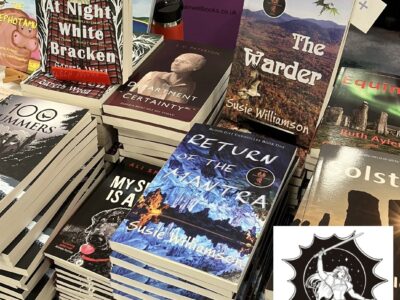
Last week was a busy writing week, working on the third instalment of Blood Gift Chronicles, and tightening the ending. The weekend was a perfect end, sharing poetry at Exeter’s St Nicholas Priory, leaning into the magical. Absorbed in the atmospheric surrounds, I thought of the temple on the island of Evren in my novel, The Warder, where magic stirs in the cavernous walls.

Magic stirs on my bookshelves too, and so I bring you two fabulous reads, with a deeply magical and atmospheric feel.
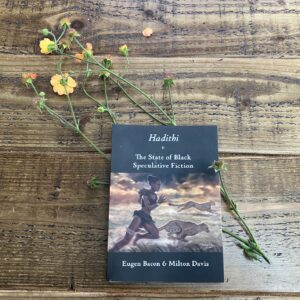
Hadithi & The State of Black Speculative Fiction by Eugen Bacon and Milton Davis
Hadithi begins with a scholarly dialogue about the uniqueness of genre-bending speculative fiction, the diversity of voices contributing from the indigenous and the diaspora, and the powerful blend of own voice narrative.
“Until black speculative fiction is normalised, there’s much work to be done.”
Following this opening, a collection of short stories bring magical tales which speak of ancestry, soul, continuity and discontinuity, all woven through various sub-genres.
Eugen Bacon brings crisp, clear visions of life. Still She Visits is the story of Segomotsi, who is 7,000 miles away from her homeland, Botswana, while her sister, Mokgosi, visits often, arriving like an African daisy: radiant, luminescent and big in bloom. As Segomotsi feels her way through the entanglements of sisterly love, she is left facing the stark truths of grief. In The Water’s Memory, Adaeze and Aloyse share the joy of their marriage, the sadness of Adaeze’s passing, and a funeral of dancing feet celebrating death as they would life. It’s a reminder of the fragility of life, the strength we strive to find for one another, and the understanding of how love can reach into those silences. In Baba Klep, Clyde and Revita crash land into a post-apocalyptic African landscape, each wearing their cleft lip with differing portrayals: for Clyde it displays the inconvenient physical pain; for Revita, it is part of her strength and beauty. On a quest to create a new, sustainable solution for the landscape, Revita’s shrewd intelligence and knowledge brings the landscape to life with the sound of locusts and birds showing the way to water, and a crude irrigation system watering an array of crops: maize, peas, cassava, bananas, beans, sweet potatoes and millet. And the tale, Ancestry, is a short, sharp shock. Aptly exploring the marginalisation of women and girls in patriarchal societies, justice brought like a punch in the gut… from a vampire.
Milton Davis brings colourful, crisp imagery and a thought-provoking lens. In Carnival, Antwon steps out into an inventive futuristic world of holoscreens, dancing tattoos, and rideout aerial traffic transporting him to the ultimate destination of Carnival, for a ‘fleeking’ good time. In Down South, Roscoe, originally from Alabama and now chauffeur to Miss Liza, agrees to journey back down south to find Miss Liza’s lost child. He finds lodgings in a local juke joint, an atmospheric place, the air heavy with a wetland organic aroma, and the sound of raucous laughter against a strumming guitar. But the danger of the times is never far away, making for an edge-of-your-seat read that makes the ending all the more satisfying. And in The Swarm, Famara, a warrior for the elders, journeys into the barren lands of the Sahel, where he sets up his makeshift lab. He soon discovers that the ground isn’t merely sand. The locust apocalypse is underway, but nothing is as it seems.
A truly exciting collection delivered through a refreshing lens. Highly recommended.
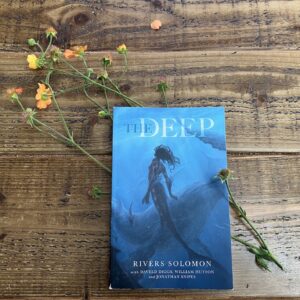
The Deep by Rivers Solomon
The Deep is the story of water dwelling descendants of pregnant African slave women, who were tragically thrown overboard into the ocean. The offspring of these descendants are called Wajinru, and were born breathing water as they did in the womb. Whales were their second mothers, who fed them, bonded with them, and took them to the deepest parts of the ocean where they could be safe. They made their home on the seabed, where the trauma faced by their ancestors is forgotten by everyone except for the historian, keeper of memories.
The main character, Yetu, is the current historian, one of extraordinary sensitivity, forced to dull her own senses to save being overwhelmed by the traumas of history. Only at the Remembrance can she find peace. It is a ceremony where she shares the memories, satisfying the Wajinru’s hunger for knowledge, a sharing that allows her to be free of the past for a time. But when the ceremony is over, memories will be returned to her, since the role of the historian is to carry the memories so others don’t have to. For Yetu it is a great burden, cursed with remembering the painful and wonderful, traumatic and the terrible, a burden so heavy she would hand herself recklessly to the sharks. She hopes that her ancestors will not continue to expect her to endure the burden, but they are needy, and so she leaves, to save herself from dying, since for Yetu, continuing to remember would be suicide.
‘The place of belonging is where loneliness ends.’
While Yetu’s story holds tragedy, it is also heart-warming. Her sensitivities are endearing, contrasted with the courage to venture into the unknown. I found the whole premise of the story to be compelling, and enjoyed the immersion into this watery world, told with a kind of poetic justice, as well as the rationale of biology and ecology explained enough to bring to life the intriguing fantastical. With themes of belonging, identity, and being true to oneself, this is a thought-provoking reflection echoing the brutal tragedy of the Atlantic Slave Trade, as well as being a colourful tale, filled with magic, captured in a watery world.
What are you reading?