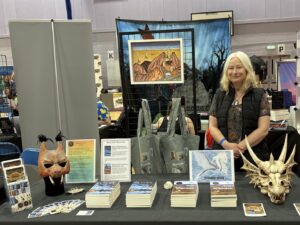
It is always a good time to watch Studio Ghibli movies, but there was another reason for selecting a rewatch of The Boy and the Heron. Next week is Eastercon 2026, and I’m looking forward to a weekend convention of all things SFF. In particular I’ll be leading a creative writing workshop on all things superpowers, and I’ll be taking part in a panel discussing libraries in the genres. I adore libraries, and there are many fictional greats to choose from, including the magical space in The Boy and the Heron…
Film Review
THE BOY AND THE HERON (2023)
Written by Hayao Miyazaki and produced by Studio Ghibli
Review by Susie Williamson
The Boy and the Heron is an animated fantasy story that begins during the Pacific War. The protagonist is a boy called Mahito, and his journey begins when his mother is killed in the war, and he is forced to leave his home in Tokyo with his father, Shoichi. Shoichi subsequently marries his late wife’s sister, Natsuko, who is pregnant and plans to be Mahito’s new mother. They move to Natsuko’s rural estate, where Mahito encounters a peculiar heron.
The homestead is a beautifully drawn world, with lush countryside and lakeside gardens framing a world where Mahito quietly navigates the grief of losing his mother, and the nightmares of the war and fire that took her. He is noticed by a heron, who in turn catches Mahito’s eye, an interaction that results in the heron leading Mahito to a sealed tower with a curious backstory. The tower was the last known location of Natsuko’s granduncle, who was an architect, said to have gone mad from too much reading. He built the tower after an extraordinary event when something appeared down from out of the sky, landing as a curious structure. The granduncle was obsessed, and built a tower around the structure, later sealing it during the great flood. After the granduncle’s demise, a maze of tunnels was discovered beneath the tower, and old wives tales tell of the tower being a gateway from which people are spirited away.
Mahito struggles to fit in at school, and following a fight, has time at home sick. His frightening nightmares and visions intensify, and his encounters with the heron become more bizarre. The heron is speaking with him, claiming that his mother is not dead, and that he can lead Mahito to his mother. It appears like a cruel promise, or a figment of imagination from an over-active mind, although on one occasion the encounter is coupled with a swarm of toads smothering Mahito. Natsuko saves Mahito, firing a whistling arrow that gets rid of the swarm. But the heron continues to be persistant in his visits to Mahito. Inspired by Natsuko, Mahito sets to work crafting his own bow and arrow, decorating it with a heron’s feather. Mahito soon discovers that the bow and arrow appears to have power beyond the strength of his bow arm.
Following an episode where Natsuko takes ill, apparently with acute morning sickness, Mahito sees her disappear into the woods. He heads out in search of her, along with an elderly maid, Kiriko, who tells him that it is in his bloodline to hear the heron speak. They arrive at the sealed tower, where Mahito beckons the heron to show itself and release Natsuko. Mahito leads the way into the tower, accompanied by the old maid against her better judgement, and the door seals behind them. The heron is there to guide them, leading them deep into the tower, tricking Mahito with a false sighting of his mother and eventually revealing its bizarre true nature, showing its inner birdman. The birdman is to guide them and Mahito, Kiriko, and the heron all sink into the floor.
Mahito arrives into an oceanic world. It is a place of flocking pelicans with malintent, of phantoms and curious cute spirits called Warawara. An adept fisherwoman becomes his guide and ally to protect him in this curious and potentially dangerous world, as he learns about the colour and magic, including Warawara bubble spirits that rise to be reborn in the other world. The characterisation and inner landscape of Mahito is beautifully drawn, as he navigates grief, and ventures into the unknown with courage and an open mind. He grows to be a plucky young hero with the capacity to see beyond his own problems and opinions to consider and empathise with different perspectives, including discovering compassion for Warawara gobbling pelicans who have no other food source. The range of characters bring an intriguing array of insight with which to consider Mahito’s plight, to discover the truth about his mother, and to rescue Natsuko. But in this ever-changing, inventive world, everything is never quite what it seems.
The colour of the story is extraordinary, a place where birds can be human, monster, or cute parakeets, a place where life and death co-exist, where temples straddle worlds, and minerals react as though with emotion. It is a feast for the imagination, reminiscent of the curiosities of Alice in Wonderland, while journeying through the complexities of a big and challenging emotional landscape for the young protagonist. And there is malevolence too, as the story does not shy away from the possibility of taking the wrong turn, becoming forever lost, losing our way and reaping the consequences. Since Mashiko has already lost his mother, he understands about permanence, able to recognise the magnitude of the decisions at hand. Themes of parallel worlds and magic portals grow, with hidden doorways and secret tunnels bringing increasing complexity to the labyrinth world. I also loved the time slip theme, brought by Himi, a young woman who is a plucky pyrokinetic intent on protecting the Warawara from pelican raids. She also saves Mahito and shows him many more doors in the tower that lead to other worlds, eventually exposing her own true identity and her significance to Mahito. Mashiko is left with a difficult choice to make: stay and carry the granduncle’s baton, to continue and hold sanctity for a world of bounty, peace and beauty, a world free from malice; or return to his world. It is a decision that involves Mahito making a fearless inventory of himself, revealing the personal growth he has made to becoming a young man who can recognise his own humanity and flaws, one not driven by ego but rather humility, with an ability of knowing when to let go, and what to serve in order to continue growing and becoming the best version of self to help others.
The Boy and the Heron is a testament to the strengths of the YA genre, the ability to pack a big story into a modest-sized space without compromising depth, the fast-paced colour, and the clarity offered to relevant and relatable challenges and ethics. The messages are layered, the backdrop is glorious, and the characterisation takes us to the edge of invention. Magical.