World Fantasy Convention 2025

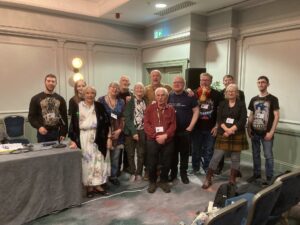
It’s the morning after a wonderfully busy weekend in Brighton, at World Fantasy Convention 2025. Big skies topped a windy and rainy sea shore coloured with a wintry Brighton Palace Pier, alongside the remains of a burnt-out west pier: history slicing the present. Tucked away from 70mph winds that battered the Sussex coast, in a seafront hotel overlooking a dramatic sea, story worlds unfolded with colour and magic, exploring the weird, the horror, and venturing into the furthest reaches.

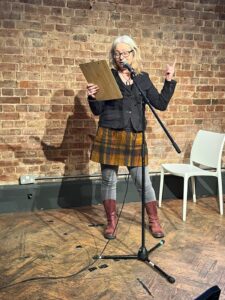
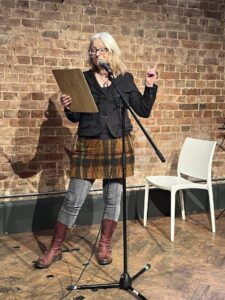
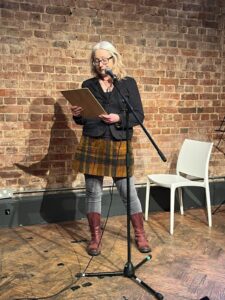
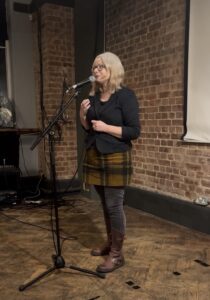
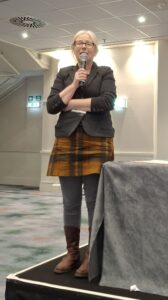
It was an honour to be on the programme, to share readings, and to join in with panel discussions talking representation, personal influences, as well as how we approach writing outside of our personal experience. With my series incorporating several characters with disabilities, it was great to share in the reminder of the need for positive representation and how we go about that.

The fantasy ecology panel was also a highlight for me. Wildlife and the environment are backdrop themes through my series, Blood Gift Chronicles, the flora and fauna layered into the worldbuilding, and into main themes around exploitation of the natural world and its people. Backdrop wildlife is largely familiar, created with a recognisable science logic, until it ventures into magic and the fantastical, further illuming the colour. It’s interesting to consider the larger than life aspects that highlight the themes, revealing the shadows, providing platforms to inspect and reflect, creating possibility, venturing to the furthest reaches of imagination. There are inventive creatures inspired by the story, and there are those venturing into familiar territory, perhaps. Various kinds of dragons come with a unique flavour, some rooted in the magic system, some created through the lens of science, all following the lore of Blood Gift Chronicles.
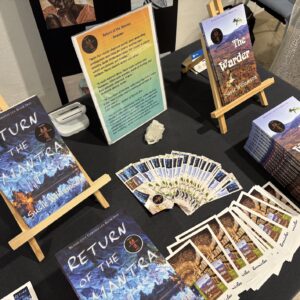
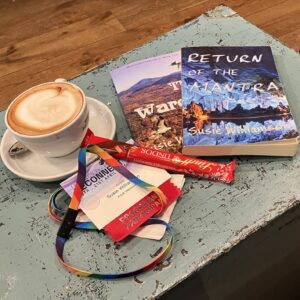
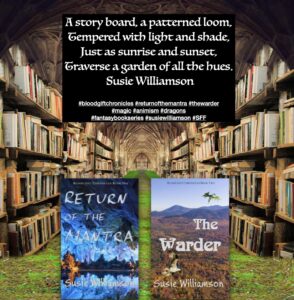
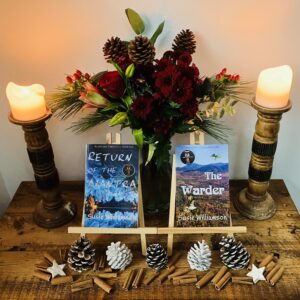
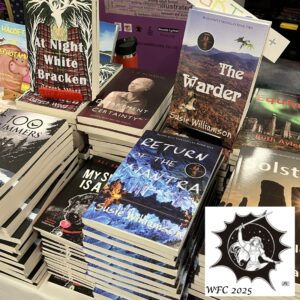
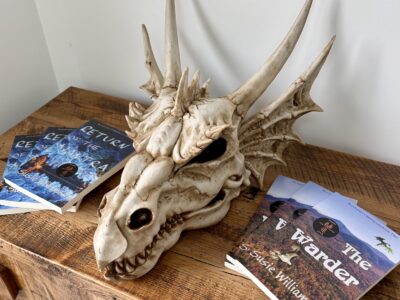
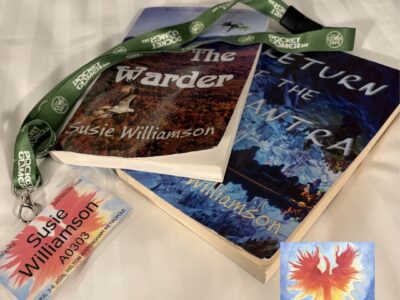
And following inspiring, thought-provoking panels, a chance to read from The Warder, Blood Gift Chronicles Book 2, to share in my love for these characters, and the gifts and curses that connect them to each other, and to the multi-faceted world. As work progresses on the third instalment, it was great to spend time with my publishers as we look ahead for what’s next in the series. With plans for next year in progress, there’s lots to look forward to.

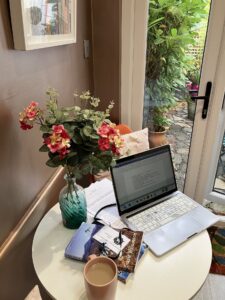
And so I start a new week inspired, as I sit at my desk and get back to work. For now I will leave you with a quote from author, Joanne Harris, best known for her novel, Chocolat, who opened the convention: ‘Fantasy is the secret language of the sub-conscious.’

Wishing everyone a wonderful week ahead.

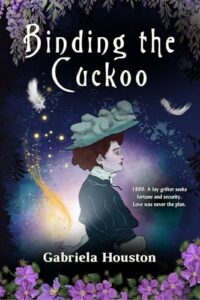
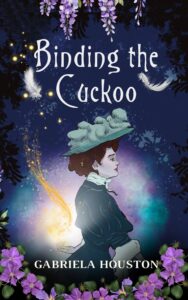
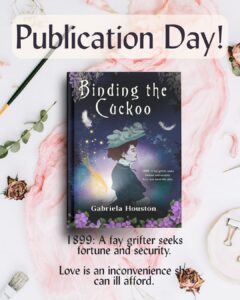
Review of Binding the Cuckoo by Gabriela Houston, written by Susie Williamson

This month I am delighted to bring to you a feature post, celebrating the recent release of Binding the Cuckoo by renowned fantasy author, Gabriela Houston.

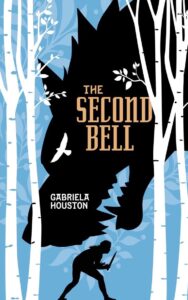
I first came across Gabriela’s work when I read The Second Bell, a fantasy book that quickly became one of my all time favourite reads. I adored the characterisation, and the intimate portrayal of communities steeped in Slavic inspired folklore. More on my review of The Second Bell can be found here.

Now I am delighted to be joining in celebrating the author’s latest release:

ABOUT THE BOOK:

In the late 19th century, a scientific marvel allows scientists to open rifts into the realms of myth. Powerful creatures, weakened and stripped of their memories, are brought to serve the whims of the wealthy elite…

In 1899 New York, Hare, a young woman with a mythical secret, finds herself trapped into servitude to the wealthy elite. When an equally desperate schoolmistress, Miss Anne Bonningham offers Hare a chance at freedom, they embark on a daring plan. Disguised as ‘Miss Edwina Walker,’ Hare navigates the treacherous waters of London high society, solely focused on securing a marriage and escaping her past.

However, amidst the glittering balls and intricate social games, Hare finds herself drawn to Ernest, a charming solicitor torn between duty to his friend and his undeniable attraction to her. As hidden agendas surface and a vengeful figure from her past threatens to expose her true identity, Hare must make a choice: embrace a life of comfort and security or choose freedom and a love that could shatter the very foundation of her world.

Binding the Cuckoo is a story of love, deception, and the fight for self-determination in a world where appearances can be deceiving, and the line between freedom and captivity is blurred.

MY REVIEW:

Binding the Cuckoo is a historical romantasy, evocative and enchanting, led by the mysterious Hare, a young woman and mythic, who is set to explore the treacherous world of London’s High Society, while attempting to outrun her past.

Hare’s journey begins in New York, where she is trapped in servitude. She carries a mythical secret, being one of the powerful creatures brought to serve the whims of the wealthy elite.  The opening scene unfolds with ease, offering an instant connection to an endearing protagonist who I was rooting for from the start. Hare possesses powerful gifts, yet is powerless by circumstance, holding no sway over the direction of her own future, prey to being summonsed at the whim of wealthy humans who look down on her kind.

Hare’s character demonstrates the experiences of othering, of being othered, held in servitude, having no autonomy or self-determination, and being of no value to those who would claim her for their own purpose and comfort. She can find herself ripped from her own reality at any moment, showing the face of humans to be monstrous and the need for Hare to be on guard and vigilant. As a servant of a wealthy household, we see her standing on the periphery, central to proceedings yet rendered invisible. Her vulnerability is stark, and her empathy for others, endearing. Freedom would be a dream, and yet when it unexpectedly comes to Hare, it is terrifying, since she is now trapped in the world of humans with no way back to the world she knows.

Anne Bonningham is the woman who freed Hare, and now their fates are tied. They travel to London, to the home of Baroness Winchfield, Miss Bonningham’s former student. Hare is introduced as Edwina Walker, Anne’s niece, and thus starts her new life. In many ways Hare is free, but she doesn’t feel free; in high society London only money and position can give true freedom, and both Hare and Anne Bonningham consider ways to achieve this, by Hare securing a good marriage.

In high society London, Hare must keep her mythic status secret. Fearing that the Baroness might discover her true identity as a summonsed pet, Hare must say little, voice no opinion, not show her intelligence. Not only does this narrative reveal the vulnerability of Hare’s existence, but also of the Baroness’s. If the Baroness were to discover Hare’s intelligence, it would shake her very foundations, since she believes that summonsed pets are mindless creatures. Hare’s life as a mythic in hiding, exposes the powerful day-to-day discriminations, themes of identity and social prejudices, messaging that reflects real world issues.

Unaware of Hare’s true identity, the Baroness decides that Hare is fine enough to introduce to court. And so begins the twists and turns of courtship, duty, survival and love.

The backdrop world is alive, lavishly textured with sumptuous attention to detail, with rich furnishings and brightly lit parlours, edged by shades of opium and gin. Among the striped trousers and fine gowns, narrative is well paced, in a story that seamlessly weaves the mundane with the fantastical with hobgoblins as butlers being a natural occurrence. The peppering of magic is delightful and intriguing, and builds into depth of narrative around themes of discrimination and othering. To add to the illusion of her fashionable existence, Anne Bonningham travels with an Eastern European cat shaped spirit, a domovoy, a character that further highlights an unjust world since this spirit is cheaper and deemed less sophisticated than its Western counterpart. In light of being a companion of Anne’s, Hare is left considering her own identity and whether she is a traitor, yet Hare and the cat spirit make for an unlikely alliance. After reflecting on how powerful the spirit is, like herself, and how nothing is truly yours if someone else could just take it away, Hare finds a way to release the domovoy. Whether it will go might be a different matter.

The narrative flows with ease, drawing you into a deep dive of decadence and shade, and into the hearts and minds of those who dwell there. Hare is settling into the highlife, muting obvious magical traits in her appearance so as to blend in and not draw attention, while watching the serving folk and empathising with their invisibility. And all the while maintaining a degree of invisibility for herself. As encounters become more familiar, Hare finds herself between two men both wanting of her affections. I enjoyed her internal narrative, exploring her mental landscape, the empathy she holds for others, while working to secure her own safety in a world in which she holds no power. It is a familiar story of survival, the duality of oppressor and oppressed, and the measures people will take to survive, and seek a way to thrive. And it begs the question what would equality look like, and what would it take to achieve that.

Romance is building in awkward meetings, told through shifting perspectives between two unlikely and potential lovers. Flirtatious encounters and confusing jealousy make for a believable dynamic that keeps you guessing, not least because the stakes are high, made more so by a threat to expose Hare’s true identity. The representation of love, and the thought-provoking questions it raises is an interesting look at authenticity, and the value of love in the face of inauthenticity.

Hare plays the part well, though never feels as though she fits. It is an inner narrative that makes for strong themes of identity, and delivers a protagonist to champion. In turn, the supporting characters are well-rounded, compelling, and with diverse perspectives to illuminate this unfolding world, and the complex relationships within it. Set in a vivid world, the narrative flows throughs the highs and lows, tensions and drama among unexpected loyalties and betrayals. It is a magical tale of uncertainty, of walking on shifting ground, of daring to hope for safety, and maybe, just maybe, finding more.

 A vivid and magical tale beautifully told.

ABOUT THE AUTHOR:

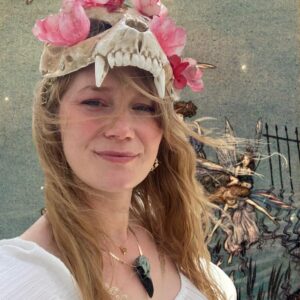
Gabriela was born and raised in Poland, brought up on a diet of mythologies and fairy tales, spending her summers exploring the woods, foraging, and animal tracking with her family. Gabriela’s two adult fantasy novels, The Second Bell & The Bone Roots were published by Angry Robot, and she has also pubished a MG duology with UCLAN. In 2024, along with 19 other authors, she crowdfunded the anthology of reimagined folktales, which she has edited and illustrated. Gabriela is the host of a YouTube channel, The Gabriela Houston Project: Storytelling in All Its Forms. She lives in London with her husband and two children.

For the Love of Books #36

It’s been a bookish kind of day in more ways than one, with a trip to Plymouth and Ferndale radio for a show celebrating books, books, and more books. Alongside two other authors, conversation illumed and inspired, and for my part, it was wonderful to bring a slice of fantasy, talking Blood Gift Chronicles, inspiration, and the craft of writing, as well as much-loved reads that inspire.

And on the theme of fantasy, and in particular the creatures that inhabit our fantasy worlds, I bring reviews of two wonderfully colourful reads.

In the Vanishers’ Palace

By Aliette de Bodard

‘In the Vanishers’ Palace’ is a dark retelling of Beauty and the Beast. It is set in a post-colonial dystopia where brutal rulers, the vanishers, wrought ruin and devastation on the land. The earth is poisoned with roaming nightmares and a deadly virus.

The story follows Yen, a woman betrayed and sold into the vanisher’s palace to pay her village’s debts, a spirited, magical and carvernous place where every door can lead to death. She is in servitude to the shape-shifting water dragon, Vu Con, a creature among the last of her kind. Vu Con is mystical, aloof and cold, but not what Yen imagined. Instead of torture and death at the hands of a dragon, Yen is expected to teach Vu Con’s two unruly children, Thong and Lien.

The story is beautifully written, with description of magic and place told with tantalising effect that draws you into what feels like a labyrinth world. Vu Con’s character is layered, unique and interesting, with an intriguing and magical appearance that left a vivid imprint in my mind. Her presence immediately challenges gender expectation. Femininity is described in both dragon and human form. As human she appears as a woman small in stature, but holding herself decisively, displaying authoritative power that is magical and dangerous. Her sexuality is explored in a merging of human and dragon form, in beautiful scenes of sapphic romance between Vu Con and Yen, exploring tenderness and the excitement of love. But again expectation is challenged, as Vu Con feels cheated that it was Yenn who came to the palace, good only for keeping Vu Con’s bed warm. Vu Con’s request had been for Yen’s mother, a wise older woman. These kind of contrasts keep the narrative sharp and the reader guessing in what is ultimately a dangerous attraction, with more twists and turns yet to come.

Binaries are challenged in a variety of ways. Motivations, intentions and actions that blend what might be deemed good and bad, are layered into complex and intriguing characters. There is diversity among the cast beyond the gender binary, with non-binary characters using they/them pronouns. And ultimately this is sapphic love between a dragon and a woman, impactful in its creation, beautiful in its descriptions that explore the intimate scenes. The author appears to deal effortlessly with what might seem impossible, shifting into dragon perspective with ease, bringing the landscape of the dragon’s mind into full view, in an entirely believable way.

An enjoyable, edgy, and beautiful tale very well told.

Fatholmfolk

By Eliza Chan

In the semi-submerged city of Tiankawi, fatholmfolk and humans live side by side. The city is revered as a perfect place, providing safe haven for those fleeing civil unrest, but beneath the veneer, revolution is brewing.
This is an ambitious and inventive story, told through characters who embody a number of fantastical creatures, including kelpies and selkies, water dragons and kappas. Narrative explores the experiences of a multi-cultural diaspora community, considering xenophobia and the way in which immigrants are defined by othering, exposing hard truths and layered complexities of individual experiences. Together with the fact that humans have polluted the oceans, forcing fatholmfolk to flee to the cities above water, a refugee crisis looms, and tension between species becomes increasingly strained.

The story is told from the perspective of main characters attempting to navigate a world that is set up against them. Mira is half-siren, the first fatholmfolk to reach the military, appointed captain of the border guard. Her partner, Kai, is a sea dragon. Cordelia is a half-octopus/half-human sea witch, who Mira has an account with. Mira has a personal interest in the welfare of fatholmfolk refugees, wanting to keep them safe in Tiankaiwan waters. Cordelia can arrange this, in return for Mira’s help with making logistical paperwork disappear, to help Cordelia’s small business to thrive. And Nami is Mira’s daughter, with a latent sea dragon side. The story begins with Nami heading out to retrieve an unhatched dragon egg that has been claimed by humans. She is an interesting character, revealing shades of grey and complexity, turning political activist, willing to cross lines in the law, while learning to own her prejudices and mistakes. Courageous to some, reckless to others, still her actions reveal startling truths about history, and the lies that followed to maintain the status quo, one that would treat fatholmfolk as livestock, while serving human kind.

I enjoyed the vibrancy and colour in this story. Worldbuilding felt to have been lovingly crafted with intriguing and insightful attention to detail, perhaps meandering between real-life reflections and the fantastical, with sea grass meadows and red pillar corals, algae-covered tables adorned with wild rice and sea grapes, vinegared fish, lotus root, cuttle fish stew, candied seaweed, taro crisps and fried water spinach. It felt like a cultural exchange, a transportive experience where I can hear the clatter of tea rooms, and the chatter of vendors in narrow canoes. For me the layered and textured tapestry of vibrancy and colour in the story was a real highlight, offering an immersive experience among an inventive cast, charged with some of the biggest social issues of our times. A highly enjoyable read.

What are you reading?

All the Shades

Pause to share, reflect and look ahead, and I hope this finds you well.

Summer is upon us, a season of sunshine, wind, rain and heatwaves that dry the grass to crisp colours of straw. But with a little nurturing, colours can be discovered and encouraged to bloom. And they have been blooming, a personal dedication to my much missed writing pal and feline friend, Mia.

More colour is found while out and about exploring, including, but not limited to, sights of bullfinch and goldfinch, hollyhocks the colour of rainbows, straw hats and sunglasses, weathered boats painted all the shades, heart-shaped lime tree leaves, barn swallows ducking and diving, and a lone puffin bobbing on gentle waves, watched and watching.

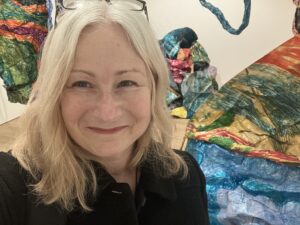
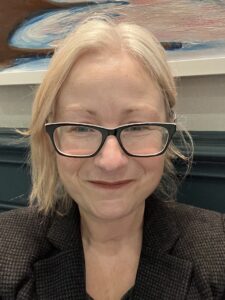
Surrounded by so much colour has been the perfect place to work on my next instalment of Blood Gift Chronicles, where the darkest places spawn the brightest shades. It is currently sitting with the publisher for the all-important edits, and here is the face of a slightly sleep-deprived writer after just hitting ‘send’.

If colour brings a feast for the senses, shades and tones of grey bring depth and life to the inner and outer landscapes of our characters. Exploring these darker shades themed heavily in my discussion panels at this year’s Eastercon in Belfast, conversation that continues to inspire.

For those already familiar with my fantasy series Blood Gift Chronicles, in amongst the colour of wildlife and the natural world, animism, magic, and dragons, you will know the reflections of the world as we know it, stories of marginalisation and social justice, themes ultimately bound with empowerment and hope. Darkness resides in decimation of the natural world, corruption and wealth inequalities, gender-based violence, and child exploitation. Hope comes in challenging the power structures to work towards environmental and social justice, and more.

In a previous blog post, Channelling Rage in SFF, I explore the landscape of anger as a character motivator. It is a well-used tool in creating powerful villains and antagonists, like Serse Lanister in Game of Thrones, a powerful woman in many ways, and powerless in others, since she is a woman in a misogynistic world, a survivor, willing to do anything to protect herself and her children. Her motivations might be understandable, even relatable, and so she garners empathy. Considering the potential to empathise with a villain, perhaps poses the question of whether it can ever be right to go bad, and where the line is drawn between villain and antagonist.

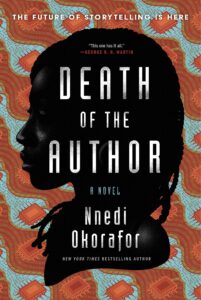
It brings to mind a well-loved read of mine: Who Fears Death by Nnedi Okorafor. There has been widespread speculation over the identity of the main character, Onye, and where she sits on the good/bad scale. While some consider that she moves to darker realms, my thoughts are that she moves from being a flawed hero to an anti-hero. SPOILER ALERT and to recap: the novel is set in post-apocalyptic Sudan following a brutal civil war. Onye is a child born of violence following the rape of her mother. She’s got powerful magic, which she gets from her father, is haunted by her father and ends up going in search of him. It leads to a violent confrontation with devasting consequences that results in Onye’s boyfriend, Mwita, being killed. Grief stricken, Onye then acts in a godlike way, maneouvring things inside her own body to conceive Mwita’s child in a kind of miraculous conception. Her actions lead to powerful consequences that result in all fertile men in the area being instantly killed, and all fertile women in the area being instantly impregnated. Onye didn’t set out to do these things, and couldn’t have foreseen these consequences, but she knowingly overreached with her powers, knowingly crossed a point of no return, and therefore turned anti-hero (to my mind). I find her character to be extraordinary, deeply endearing for the most part, with a story arc that reveals strong contrasts as well as the subtle colour and textured tapestry of her desert home, all the shades, from the lightest, to the dark.

All the shades are what I venture to write in Blood Gift Chronicles, light and dark woven through each instalment of the series, culminating into the work in progress, and the colours of the origin… It’s a world I look forward to returning to, and to ultimately releasing this third instalment into the world.

For now back to the colours of the real world.

And wishing you a wonderful and colour-filled week.

For the Love of Books #35

Last week was a busy writing week, working on the third instalment of Blood Gift Chronicles, and tightening the ending. The weekend was a perfect end, sharing poetry at Exeter’s St Nicholas Priory, leaning into the magical. Absorbed in the atmospheric surrounds, I thought of the temple on the island of Evren in my novel, The Warder, where magic stirs in the cavernous walls.

Magic stirs on my bookshelves too, and so I bring you two fabulous reads, with a deeply magical and atmospheric feel.

Hadithi & The State of Black Speculative Fiction by Eugen Bacon and Milton Davis

Hadithi begins with a scholarly dialogue about the uniqueness of genre-bending speculative fiction, the diversity of voices contributing from the indigenous and the diaspora, and the powerful blend of own voice narrative.

“Until black speculative fiction is normalised, there’s much work to be done.”

Following this opening, a collection of short stories bring magical tales which speak of ancestry, soul, continuity and discontinuity, all woven through various sub-genres.

Eugen Bacon brings crisp, clear visions of life. Still She Visits is the story of Segomotsi, who is 7,000 miles away from her homeland, Botswana, while her sister, Mokgosi, visits often, arriving like an African daisy: radiant, luminescent and big in bloom. As Segomotsi feels her way through the entanglements of sisterly love, she is left facing the stark truths of grief. In The Water’s Memory, Adaeze and Aloyse share the joy of their marriage, the sadness of Adaeze’s passing, and a funeral of dancing feet celebrating death as they would life. It’s a reminder of the fragility of life, the strength we strive to find for one another, and the understanding of how love can reach into those silences. In Baba Klep, Clyde and Revita crash land into a post-apocalyptic African landscape, each wearing their cleft lip with differing portrayals: for Clyde it displays the inconvenient physical pain; for Revita, it is part of her strength and beauty. On a quest to create a new, sustainable solution for the landscape, Revita’s shrewd intelligence and knowledge brings the landscape to life with the sound of locusts and birds showing the way to water, and a crude irrigation system watering an array of crops: maize, peas, cassava, bananas, beans, sweet potatoes and millet. And the tale, Ancestry, is a short, sharp shock. Aptly exploring the marginalisation of women and girls in patriarchal societies, justice brought like a punch in the gut… from a vampire.

Milton Davis brings colourful, crisp imagery and a thought-provoking lens. In Carnival, Antwon steps out into an inventive futuristic world of holoscreens, dancing tattoos, and rideout aerial traffic transporting him to the ultimate destination of Carnival, for a ‘fleeking’ good time. In Down South, Roscoe, originally from Alabama and now chauffeur to Miss Liza, agrees to journey back down south to find Miss Liza’s lost child. He finds lodgings in a local juke joint, an atmospheric place, the air heavy with a wetland organic aroma, and the sound of raucous laughter against a strumming guitar. But the danger of the times is never far away, making for an edge-of-your-seat read that makes the ending all the more satisfying. And in The Swarm, Famara, a warrior for the elders, journeys into the barren lands of the Sahel, where he sets up his makeshift lab. He soon discovers that the ground isn’t merely sand. The locust apocalypse is underway, but nothing is as it seems.

A truly exciting collection delivered through a refreshing lens. Highly recommended.

The Deep by Rivers Solomon

The Deep is the story of water dwelling descendants of pregnant African slave women, who were tragically thrown overboard into the ocean. The offspring of these descendants are called Wajinru, and were born breathing water as they did in the womb. Whales were their second mothers, who fed them, bonded with them, and took them to the deepest parts of the ocean where they could be safe. They made their home on the seabed, where the trauma faced by their ancestors is forgotten by everyone except for the historian, keeper of memories.

The main character, Yetu, is the current historian, one of extraordinary sensitivity, forced to dull her own senses to save being overwhelmed by the traumas of history. Only at the Remembrance can she find peace. It is a ceremony where she shares the memories, satisfying the Wajinru’s hunger for knowledge, a sharing that allows her to be free of the past for a time. But when the ceremony is over, memories will be returned to her, since the role of the historian is to carry the memories so others don’t have to. For Yetu it is a great burden, cursed with remembering the painful and wonderful, traumatic and the terrible, a burden so heavy she would hand herself recklessly to the sharks. She hopes that her ancestors will not continue to expect her to endure the burden, but they are needy, and so she leaves, to save herself from dying, since for Yetu, continuing to remember would be suicide.

‘The place of belonging is where loneliness ends.’

While Yetu’s story holds tragedy, it is also heart-warming. Her sensitivities are endearing, contrasted with the courage to venture into the unknown. I found the whole premise of the story to be compelling, and enjoyed the immersion into this watery world, told with a kind of poetic justice, as well as the rationale of biology and ecology explained enough to bring to life the intriguing fantastical. With themes of belonging, identity, and being true to oneself, this is a thought-provoking reflection echoing the brutal tragedy of the Atlantic Slave Trade, as well as being a colourful tale, filled with magic, captured in a watery world.

What are you reading?

News, Updates, and Eastercon 2025, Belfast Style

Summer is on its way and I can barely believe it’s the end of May, and so for an overdue catch up on a wonderful trip to Northern Ireland, where Eastercon 76 was being held, Belfast style.


It was a privilege to take part in a fantastic programme of panels, workshops and readings. The stars aligned to theme me on the dark side this year, those big emotions that can drive our characters, as well as create opportunity for reflecting in a different way, one that might just interrupt the fear and lend itself to peace. Determined rage can be a powerful motivator, especially when fuelled by a sense of injustice. And perhaps hope as determined rage in a state of resilience and unwavering belief, a deep persistent hope, can be as powerful and forceful in driving action and change. My characters are no stranger to the dark side. They’re also no stranger to fighting back, working together, supporting a world to move towards greater environmental and social justice, and so there are messages of hope and empowerment. And we need those, right?

I look forward to sharing more thoughts of these intriguing topics, but for now simple gratitude to all the inspiring and inventive writers out there, and readers who share a love of the genres.

Belfast ICC was an impressive host, and further afield beneath big skies it was great to explore memorials and street art and an impressive city hall. Not to mention the Titanic museum, and a t-shirt that read: ‘It was fine when it left Belfast, so it was.’

Nearby Game of Thrones studios was a real highlight, a feast of visuals, sets and insights bringing this epic saga to life.

And it was great to see more sights of this country, with beautiful coastline and stunning interior carpeted with yellow gorse, and meeting locals who were extraordinarily gracious, welcoming and friendly.

Giants Causeway was magic, a place of myth and legend.

Carrick a Rede rope bridge was appropriately scary, hanging 60ft over choppy seas, though tame in comparison to fishermen’s tales of traversing a single rope carrying their catch of the day!

And more exploring Game of Thrones territory with Dunlace Castle (in exceptional wind and rain!!), not to mention, Ballintoy Harbour.

Dark Hedges was truly evocative.

And Cushendun Caves, nestled on the wild tip of the quaint village of Cushendun, was closed for the season, or perhaps because the red woman was cooking up magic.

Finally home and a chance to rest and restore before change. Because change comes whether we want it or not.

And now for some truly sad news. I have had to say goodbye to my beloved Mia, cat companion and writing buddy for all her fifteen years. She has had her bed on my desk ever since she was a kitten, and been with me through the ups and days of writing, editing, rejection and publishing. Until illness came and transformed lovely Mia into magic, leaving my desk all too bare.

Though she was also a wonderful gardener, and outside the colours bloom.

If you ever wondered where inspiration for the mountain lions of Shendi came from in Return of the Mantra, look no further than this gorgeous girl, who used to sport a mane in her younger days.

Rest easy sweet girl…

And after she had slipped away, a flower sprung where she had a lain, forget-me-not, the petals say, in Mia’s grounds, the perfect place.

💙