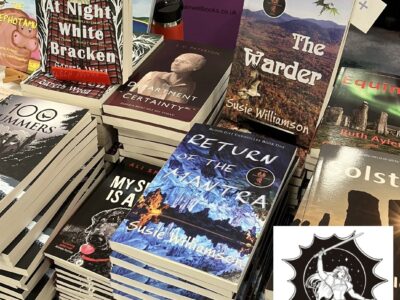
It’s been a bookish kind of day in more ways than one, with a trip to Plymouth and Ferndale radio for a show celebrating books, books, and more books. Alongside two other authors, conversation illumed and inspired, and for my part, it was wonderful to bring a slice of fantasy, talking Blood Gift Chronicles, inspiration, and the craft of writing, as well as much-loved reads that inspire.

And on the theme of fantasy, and in particular the creatures that inhabit our fantasy worlds, I bring reviews of two wonderfully colourful reads.
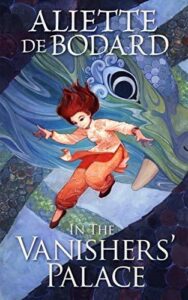
In the Vanishers’ Palace
By Aliette de Bodard
‘In the Vanishers’ Palace’ is a dark retelling of Beauty and the Beast. It is set in a post-colonial dystopia where brutal rulers, the vanishers, wrought ruin and devastation on the land. The earth is poisoned with roaming nightmares and a deadly virus.
The story follows Yen, a woman betrayed and sold into the vanisher’s palace to pay her village’s debts, a spirited, magical and carvernous place where every door can lead to death. She is in servitude to the shape-shifting water dragon, Vu Con, a creature among the last of her kind. Vu Con is mystical, aloof and cold, but not what Yen imagined. Instead of torture and death at the hands of a dragon, Yen is expected to teach Vu Con’s two unruly children, Thong and Lien.
The story is beautifully written, with description of magic and place told with tantalising effect that draws you into what feels like a labyrinth world. Vu Con’s character is layered, unique and interesting, with an intriguing and magical appearance that left a vivid imprint in my mind. Her presence immediately challenges gender expectation. Femininity is described in both dragon and human form. As human she appears as a woman small in stature, but holding herself decisively, displaying authoritative power that is magical and dangerous. Her sexuality is explored in a merging of human and dragon form, in beautiful scenes of sapphic romance between Vu Con and Yen, exploring tenderness and the excitement of love. But again expectation is challenged, as Vu Con feels cheated that it was Yenn who came to the palace, good only for keeping Vu Con’s bed warm. Vu Con’s request had been for Yen’s mother, a wise older woman. These kind of contrasts keep the narrative sharp and the reader guessing in what is ultimately a dangerous attraction, with more twists and turns yet to come.
Binaries are challenged in a variety of ways. Motivations, intentions and actions that blend what might be deemed good and bad, are layered into complex and intriguing characters. There is diversity among the cast beyond the gender binary, with non-binary characters using they/them pronouns. And ultimately this is sapphic love between a dragon and a woman, impactful in its creation, beautiful in its descriptions that explore the intimate scenes. The author appears to deal effortlessly with what might seem impossible, shifting into dragon perspective with ease, bringing the landscape of the dragon’s mind into full view, in an entirely believable way.
An enjoyable, edgy, and beautiful tale very well told.
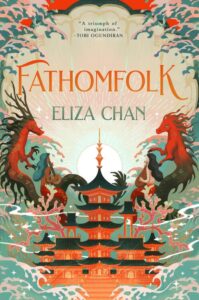
Fatholmfolk
By Eliza Chan
In the semi-submerged city of Tiankawi, fatholmfolk and humans live side by side. The city is revered as a perfect place, providing safe haven for those fleeing civil unrest, but beneath the veneer, revolution is brewing.
This is an ambitious and inventive story, told through characters who embody a number of fantastical creatures, including kelpies and selkies, water dragons and kappas. Narrative explores the experiences of a multi-cultural diaspora community, considering xenophobia and the way in which immigrants are defined by othering, exposing hard truths and layered complexities of individual experiences. Together with the fact that humans have polluted the oceans, forcing fatholmfolk to flee to the cities above water, a refugee crisis looms, and tension between species becomes increasingly strained.
The story is told from the perspective of main characters attempting to navigate a world that is set up against them. Mira is half-siren, the first fatholmfolk to reach the military, appointed captain of the border guard. Her partner, Kai, is a sea dragon. Cordelia is a half-octopus/half-human sea witch, who Mira has an account with. Mira has a personal interest in the welfare of fatholmfolk refugees, wanting to keep them safe in Tiankaiwan waters. Cordelia can arrange this, in return for Mira’s help with making logistical paperwork disappear, to help Cordelia’s small business to thrive. And Nami is Mira’s daughter, with a latent sea dragon side. The story begins with Nami heading out to retrieve an unhatched dragon egg that has been claimed by humans. She is an interesting character, revealing shades of grey and complexity, turning political activist, willing to cross lines in the law, while learning to own her prejudices and mistakes. Courageous to some, reckless to others, still her actions reveal startling truths about history, and the lies that followed to maintain the status quo, one that would treat fatholmfolk as livestock, while serving human kind.
I enjoyed the vibrancy and colour in this story. Worldbuilding felt to have been lovingly crafted with intriguing and insightful attention to detail, perhaps meandering between real-life reflections and the fantastical, with sea grass meadows and red pillar corals, algae-covered tables adorned with wild rice and sea grapes, vinegared fish, lotus root, cuttle fish stew, candied seaweed, taro crisps and fried water spinach. It felt like a cultural exchange, a transportive experience where I can hear the clatter of tea rooms, and the chatter of vendors in narrow canoes. For me the layered and textured tapestry of vibrancy and colour in the story was a real highlight, offering an immersive experience among an inventive cast, charged with some of the biggest social issues of our times. A highly enjoyable read.
What are you reading?