Tag: Ursula Le Guin

Left Hand of Darkness and the Tao Te Ching

Days slip into August, WorldCon is on the way, a hedgehog friend has moved into the garden, a lone Canada Goose with a broken wing finds support riverside, plenty of writing is underway, as well as reading. I don’t usually publish reading blogs side by side, but I’ll make an exception, for the special times when what books we might choose from the shelf intersect with life. Perhaps that is always the case, although I’m speaking of some happy, by-chance crossovers brought by the author who keeps on giving, Ursula Le Guin.
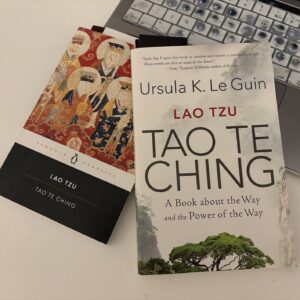
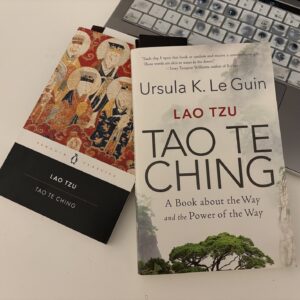
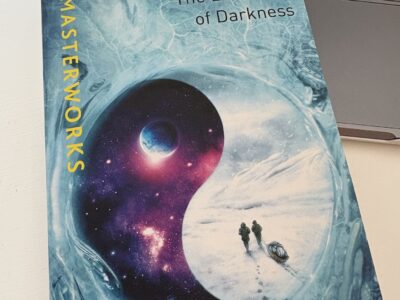
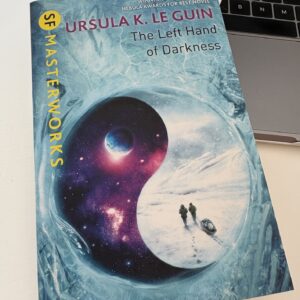
I had thought to re-read The Left Hand of Darkness a while ago, a book I remembered as thought-provoking, and layered. I wondered what more messages I might receive this time around. I started, I put it down, I wasn’t sure why, time went by. Meanwhile I had stumbled on Tao Te Ching by Lao Tzu. No sooner was I graced by Lao Tzu’s philosophy, when I realised Ursula Le Guin had written her own translations in her writings, Lao Tzu, Tao Te Ching. Reading these texts side by side, the layering of messages seeped through into the moment, and I received my first new realisation of The Left Hand of Darkness: it’s so obvious, with the yin yang symbolism on the cover, but only now was I able to feel the inspiration that moved the stories. This time around I devoured the pages, following the stories as told by Genly Ai, transcripts from his diplomatic mission to the alien world of Winter in the lands of Karhide. The narrative is hugely colourful, the language engaging and evocative, revealing an intriguing and complex world, alongside Genly Ai’s internal dialogue.

This is a wonderfully imaginative and intuitive journey, revealing the light and shade, and the flow of energies through lands and stories gathered along the way. The author’s attention to detail on human complexities, the ability to reflect and switch the lens on commonplace themes makes for a captivating narrative. There are reflections on othering, feeling like an outsider, the work towards seeing through the eyes of others rather than through our own, thereby decentring the experience of the narrator and moving to empathy. There is a timeless quality to the messaging, relevant to contemporary themes and challenges of patriotism and nationalism, with thoughts offered about isolationism being rooted in fear. There are offerings of karmic shadows and the times to walk away, while owning everything. There are warnings of foretelling, and discussion of balance, knowing when to take action, and understanding when action grows unprofitable, when to seek information and when information grows unprofitable, and knowing when to simply sleep.

The Left Hand of Darkness was first published in 1969, and I feel in places some discernment is now also necessary in the reading. With renewed and deeper understandings, Ursula Le Guin herself reflects on her writing career, in places recognising how she would approach some things differently if she were to write them now. The evolving dialogue between author and work in itself is in keeping with themes in the aforementioned works: the process of life, the lessons learned, and the timeless quality of a perceptive, intuitive and insightful lens.

If you’re so inclined, I’ll leave you with a link to an interview Ursula Le Guin gave on her thoughts and relationship with Taoism. Click here.
For the Love of Books #26

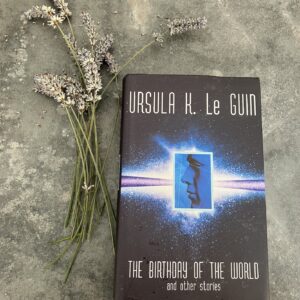
If ever I needed a reminder of the heights of great worldbuilding, this collection, from one of our great SFF pioneers, Ursula Le Guin, offers a masterclass. Eight short stories and novellas bring us worlds near and far, those travelling between worlds, and shifting perspectives from outwards to inwards with thought-provoking poignancy.

The Birthday of the World; by Ursula Le Guin

To give you a sneak peek into the inner workings…

The Birthday of the World

The Birthday of the World is considered to be the time the sun stands over Mount Kanaghadwa, when people count themselves a year older, although the rituals and ceremonies are no longer remembered. In a society struggling with their concept of god, the narrator reflects on their own beliefs, rituals and ceremonies, layering a world where gods dance and die, and wild dragons fly. But with wars at the borders, lands have grown too large and the existence of God itself is threatened. The world must die so that God may live, and so the narrator is left pondering the identity of God itself.

Old Music and the Slave Women

Esdan, a chief intelligence officer, ends up on a clandestine mission during a civil war. Intercepted by government forces, he is imprisoned on a large slave estate, where his perspective becomes increasingly limited. In a brutal world, this is a story of survival, and hopeful endeavour in the coming revolution. Will the rebellion reach them? From humiliating violence, to muddy waters of human inequity in supposed liberation, to the failings of world construct to deliver utopia, it is in the bonds between slaves that kindness and comfort is found, and where the heart of the story lies.

Paradise Lost

On a multi-generational voyage to a potentially habitable planet, Liu Hsing and Nova Luis are members of the fifth generation born on the space ship. Many are excited by the idea of discovery, a planet to explore and send information back to the human species. But some people, especially the older generation, subscribe to the religion of Bliss – the state of a blissful journey, with no end. For them, Bliss is the only reason to stay alive. Liu and Nova are faced with followers of the religious cult who question if living on a planet is such a joy. There are also environmental themes, highlighting the challenge of making change, and the overall question of what is natural and what is not. An interesting read, fascinating in its construct, and thought-provoking in the themes of isolation, religion and utopia.

Solitude

Solitude is told by the narrator, as she reflects on her experiences growing up on Eleven-Soro. Her mother was an Observer, whose work involved settling among the native people of Eleven Soro, to learn about this complex alien world. Cultural differences between mother and daughter eventually drive them apart. Where the mother shuns the alien culture, the narrator adopts it as her own, wanting to grow her soul and experience what it means to be  a person of that culture. It is a theme reflective of generational confusion, complicated by outside influence. It is also an interesting use of perspective, approaching the culture of Eleven-Soro from a colonised mindset, yet entirely shifting perspective onto a young woman who becomes part of it. Cultural norms are highlighted, which require societies of modest population, driven by a desire for solitude and the social norm being introverts, perhaps essentially selecting for autism. In true style of Ursula Le Guin, subverted expectations are delivered with ease, which illuminate and surprise, in this creative and thought-provoking world.

The Matter of Seggri

Set in the dystopian society of Seggri, the story is written as a first contact report on the ship’s log of the Wandership. The captain describes a complex society which demonstrates gender as a social construct. Gender expectation is subverted and replaced with inventive roles. The impact of colonialism is also questioned, with consideration given to a society destabilised by outside contact. Previous colonial interference messed with chromosomes, which now results in there being sixteen women for every one man. In the present day, men have all the privilege and women have all the power. Given the opportunity, would men cling to their privileged status or demand freedom, and would women resist giving up their power? Would the sexual system break down?

Unchosen Love

In a world textured with colour, legend and mystery, a polygamous society is structured around family units called sedoretu. Hadri has been chosen to join one such family, after a man seeks out his affections. Homosexual and heterosexual coupling is commonplace, and various aspects of relationships are explored, including the more insidious coercive control.

‘Being unhappy in a room is worse than being unhappy outdoors.’

It is following one mysterious encounter that Hadri comes to realise his true feelings. It is a startling discovery, not least for himself, and brings with it a tantalising coming-of-age feel.

Mountain Ways

This story continues with the themes from Unchosen Love, with society structured around the same sedoretu units. Two women fall in love outside of convention, but over time they conform and strive to form a sedoretu. Through it we see the cost of compromise, the bitterness of conformity and restriction, a stark contrast to two previously independent souls. It was an intriguing and illuminating play on character, that also undoubtedly left a bitter taste. There was also an interesting interplay with the natural world, challenging the concept of ownership. I particularly enjoyed the portrayal of environmental equity.

Coming of Age in Karhide

Set on the fictional planet of Gethen, a place where adults have no fixed gender identity, the story follows Sov Thade Tage em Ereb, a teenager living in a large communal home in the Karhidish city of Rer. As Sov experiences biological changes, it is clear they are ready for kemmer, held in a communal Kemmerhouse for those sexually receptive. Any children conceived in the Kemmerhouse are raised in the communal home, the hearth. Sov and their friend, both ready for kemmer, express fears that being in kemmer is dehumanizing, being seen as a sex machine. And so Sov’s coming of age story is told, of changing bodies and sexuality that was utterly relatable, as well as a meaningful alternative look into gender identity in a place where, quite simply, love is love.

What are you reading?